 Campbell Mushroom Farm
More Than a Mushroom: Understanding Cordyceps
Cordyceps fungus is quite a fascinating organism to study. In the wild, it is found as a parasite to insects! Interestingly enough though, it is not even a mushroom. It is an Ascomycete fungus, meaning it is actually more closely related to molds and yeasts than the mushrooms you would find in the grocery store! It is known in eastern medicine to boost stamina and improve circulation, but more scientific evidence is needed to confirm these findings.
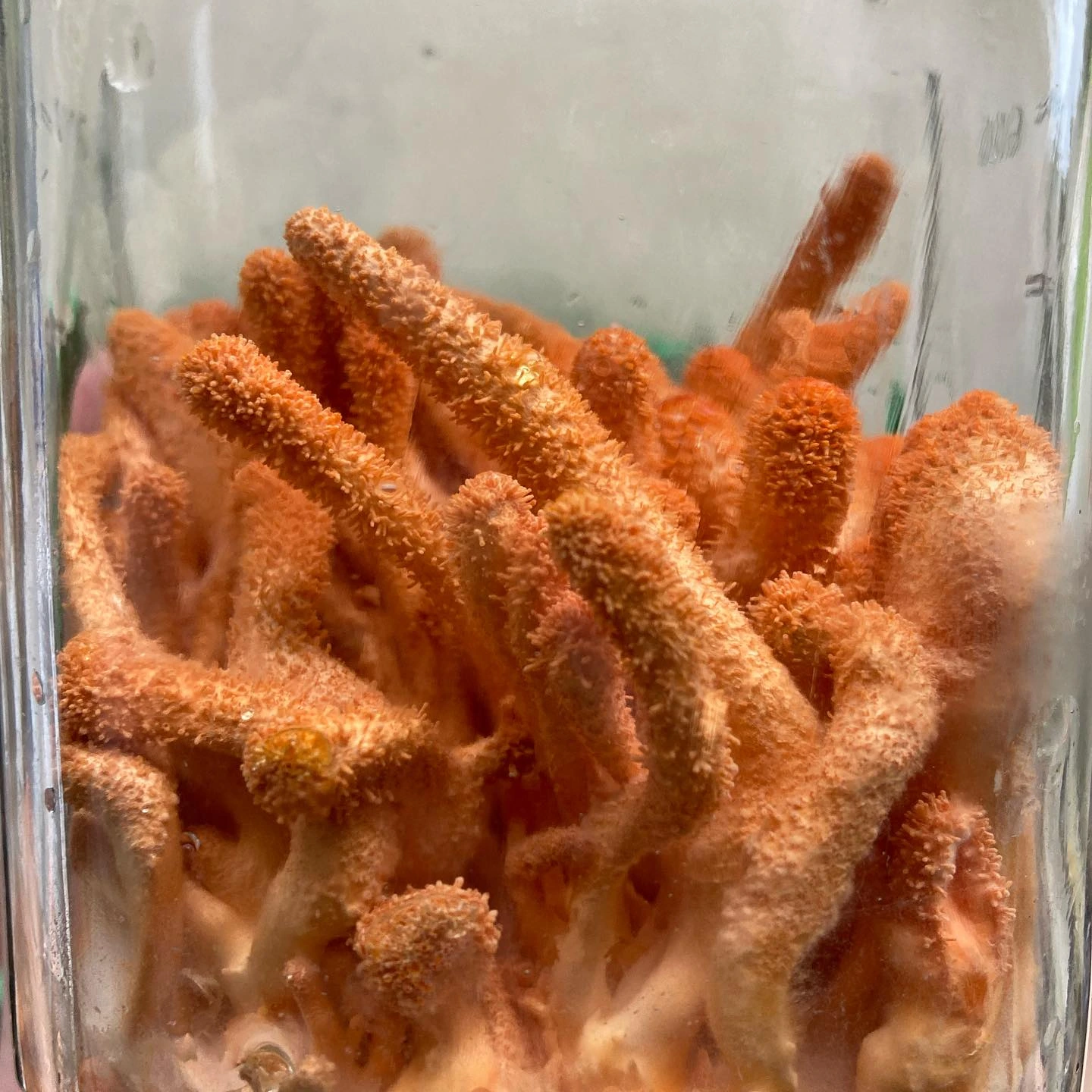
Cordyceps fungus is easy to grow, with several requirements:
- A viable strain - This species is prone to "senescence" or a gradual aging/degrading of cultures that cannot be reversed. Because of this, the Cordyceps cultivator must work to continuously develop and acquire new strains. I used the multi-ascospore collection method for my strain development by harvesting my largest fruit body and sticking it to the top of a deep petri dish via Vaseline, allowing the spores to drop onto agar, and collecting the mycelium that would subsequently grow from the germinated spores. By doing this and testing out different strains in fruiting, I was able to develop strains with a far greater vigor than the liquid culture I begun with. For development of long term strain vigor and maximum genetic diversity, the single ascospore technique can be employed with multiple strain lines as well as wild foraged fruit bodies.
- Sterile conditions - Cordyceps substrate is nutrient rich, so if not properly sterilized prior to inoculation is at risk of contamination. A sterilization of substrate at 90+ mins at 15 psi is a requirement. A still air box or laminar flow hood during inoculation is a must.
- Colonization in complete darkness - if exposed to light during colonization, growth can be stunted.
- A long incubation period - 60ish days to reach full maturity after the colonization period.
- Cool temperatures - Cordyceps die back in temperatures much over 70 degrees F.
I found growing these mushrooms out of mason jars to be simplest method. Simply add substrate mix to the jar, pressure cook for 90+ mins at 15 psi, and inoculate via self healing injection ports with LC. Make sure your jars have a filter patch for air exchange. If you are serious about cultivating Cordyceps millitaris fungi, I highly recommend checking out the work of William Padilla-Brown, who pioneered Cordyceps tek in the US.
Although many folks these days use very elaborate liquid culture recipes, I stuck with simple honey water for longer shelf life and consistency.